
Powering Modern Agriculture with Smart Drone Spraying Solutions
Agriculture · BADC · Nilphamari, Bangladesh
Overview
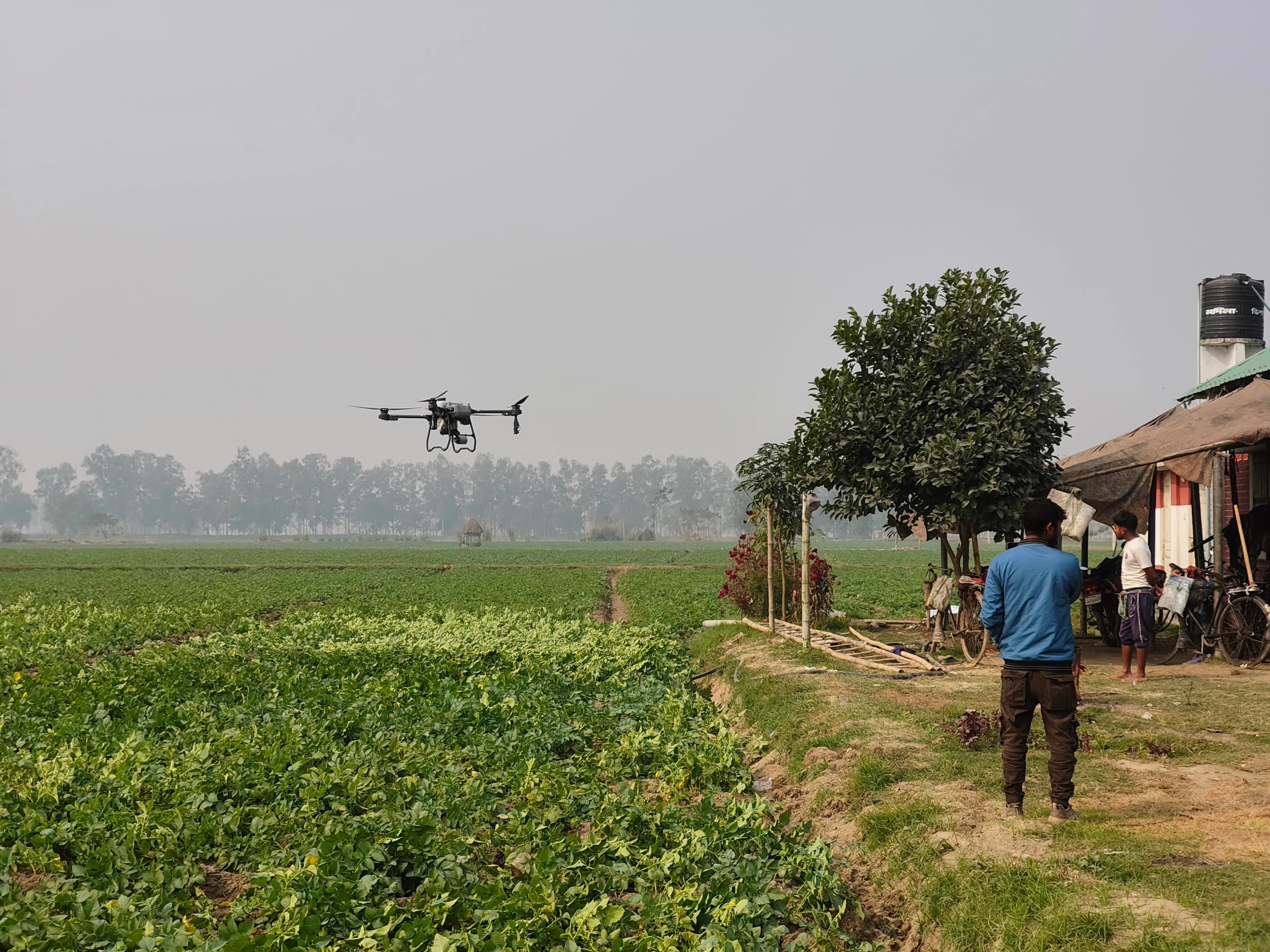
In Bangladesh, farming is still very hands-on and traditional. Many farmers work in small, scattered fields, often dealing with rain, floods, and muddy land. Spraying is usually done manually—farmers carrying heavy backpacks and walking through crops for hours. It’s hard work, it exposes them to chemicals, and still doesn’t always give even coverage across the field. Our spraying operations are designed to address these everyday realities by introducing UAV- based precision agriculture. We work with local farmers, agricultural enterprises, and Bangladesh Agricultural Development Corporation (BADC) programs, helping gradually shift from manual spraying to more efficient drone-based methods. In projects like our Nilphamari operation covering 200+ acres, UAV technology has shown faster application, consistent coverage, and safer field operations—supporting the move toward more modern and productive farming in Bangladesh.
The Challenge
The limitations of traditional agriculture are very clear. Farmers often apply 200–300 liters of
pesticide solution per acre using manual, labor-intensive methods, which increases cost, slows
operations, and exposes workers to chemical risks.
In our early UAV pilot projects, we observed that even with drone adoption, usage efficiency was
around 80–85 liters per acre—an improvement in effort but not yet optimized for large-scale cost
and productivity needs. This led us to refine spray settings, flight parameters, and field execution
methods through repeated trials to improve efficiency and consistency.
Another major challenge remains the field reality in Bangladesh and similar regions, where
fragmented land, difficult access, and coordination requirements increase operational complexity.
We also face hardware constraints, as most global UAV systems are designed for large uniform
farms, making scaling in local conditions more difficult due to cost, maintenance, and
dependency on imported parts.
Our Solution
To address these challenges, ANTS built a structured UAV spraying system focused on precision,
efficiency, and scalability. Using planned flight paths and calibrated spraying with the DJI Agras
T25, we improved coverage consistency while reducing manual effort and chemical usage.
Results
During our pilot work in areas like Nilphamari, we gradually improved performance through real
field trials, but we also identified a key limitation—the drone’s size and handling made
operations difficult in small, fragmented fields and tight-access areas common in Bangladesh.
At ANTS, the focus remains on making drone-based agriculture more practical, adaptable, and
truly usable in real farming environments.
Gallery